


What Is Agentic Shopping? How AI Moved From Reacting to Acting
TL;DR
Last updated: November 2026
Agentic shopping is shopping where an AI agent acts on your behalf: it discovers, compares and curates products and, with your approval, can complete the purchase. Glance, your intelligent shopping agent, starts before you search. It reads weather, location, local trends, occasions and, if you choose, your selfie, then shows complete, shoppable looks on you.
- Not a chatbot. Chatbots and recommendation engines respond when you ask. An agentic system plans, acts and learns across steps.
- Five specialist agents and one orchestration layer build each look from a catalog of more than 40 million products [confirm].
- Checkout is part of the flow. Glance announced native PayPal checkout for supported merchants on October 15, 2026. The wider standards behind agent checkout are explained in what agentic commerce is.
- You stay in control. Glance builds the look, and you decide whether to buy.
- The evidence is early but promising. Adobe found AI-referred visits to US retail sites converted 31% better in the 2025 holiday season, and McKinsey projects $900 billion to $1 trillion in agent-orchestrated US B2C retail revenue by 2030.
Let's be honest: online shopping in 2026 should feel easier than it does. You have more tools than ever, including AI assistants, recommendation engines, style quizzes and "people also bought" carousels. And somehow the Friday-night experience of closing fifteen tabs without buying a thing is more common, not less.
The problem isn't the tools. It's the model. Most of them still wait for you to start. Search. Browse. Filter. The work still lands on you.
Agentic shopping is what changes when AI stops waiting. Instead of responding to a query, it reads context before you ask:
- Your physical features, if you choose to share a selfie
- Your location and the weather outside
- What's trending in your city
- The occasions you are dressing for, from holidays to events
The output isn't a list of products. It's a complete, styled look built around who you actually are, surfaced before you think to ask.
Glance describes itself as the world's first multi-agent agentic shopping platform. This guide explains what agentic shopping means, how it works and where it is headed with real retailer examples covered separately.
What Is Agentic Shopping?
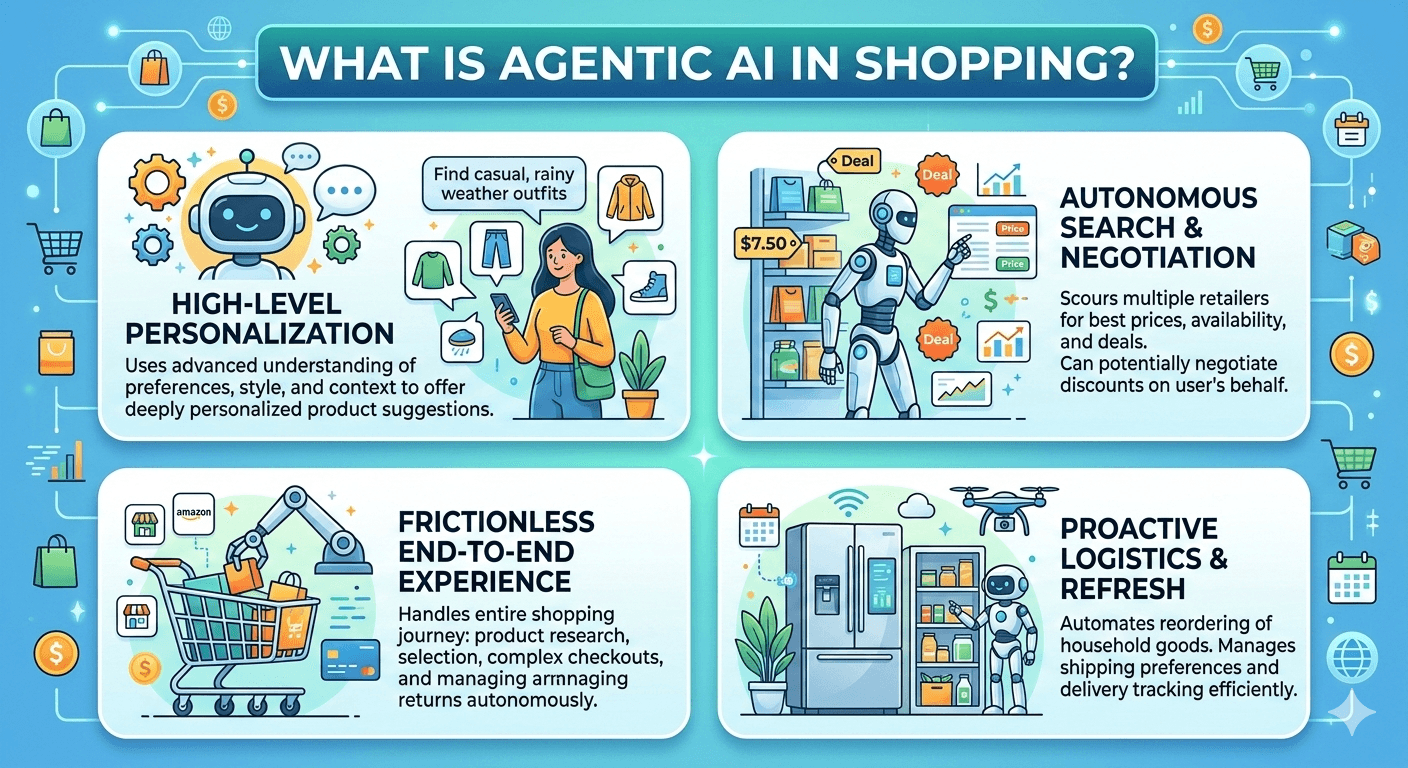
In the broader industry, agentic shopping describes AI agents that research products, compare options, build carts and, within limits you set, complete purchases on your behalf.
Agentic shopping refers to AI systems that act on your behalf: not just recommending, but planning, discovering and curating purchases from your goals, context and identity, without waiting for a search query. Glance, your intelligent shopping agent, is built on this model. It is the consumer side of agentic commerce, which also covers the protocols and payments that complete a sale.
Here's a concrete (illustrative) example. You're heading to Austin next weekend. A traditional shopping experience waits for you to search "Austin weekend outfits." An agentic system like Glance can already work from your face shape and skin tone, if you shared a selfie, the Austin forecast (79°F, partly cloudy), what's trending in Texas right now and the Saturday-night dinner you tell it about. It has already generated a look. You didn't ask for it.
That's the shift. Not smarter search. A different starting point entirely.
Glance is embeddedmore than 125 million TV devices and more than 13 million active users across mobile worldwide.
Agentic shopping compared with chatbots and recommendation engines
| Recommendation engine | AI chatbot or assistant | Agentic shopping | |
| Starts when | You browse | You ask | You set a goal, or the agent acts on your context (Glance starts before you search) |
| What it does | Suggests similar items | Answers and suggests | Plans, compares, builds carts and can act |
| Who decides | You | You | You approve, within limits you set |
| Examples | "Customers also bought" | Alexa for Shopping, ChatGPT | Retailer and platform agents, and Glance |
Proactive vs Reactive: The Structural Difference that Actually Matters
Most AI shopping tools are reactive: you open an app, type something, and they respond. Proactive tools start from your context. The difference is the trigger, not the speed and it isthe core of proactive vs reactive AI shopping.
How Glance's Multi-Agent Intelligence Works (Without the Tech Talk)
Most AI shopping tools run on a single model that tries to handle everything at once: read your preferences, match products, factor in context. The problem isn't effort. It's depth. A generalist model learns broad patterns across millions of users and can't go deep on any individual signal.
Glance is built on a different architecture: five specialized AI agents, each focused on one domain, running at the same time. A central orchestration layer synthesizes their outputs into one coherent result, a complete, styled look that reflects all five signals at once.
The five agents
- The Weather and Location Agent reads real-time conditions in your city. A rainy Chicago Tuesday needs a different output than a sunny Miami weekend: fabric weight, layering and coverage all change.
- The Regional Trends Agent tracks micro-trends specific to your city right now. Global trend forecasts are noise if you live in Nashville and the data is from Seoul.
- The Occasions Agent factors in the occasion, such as holidays, seasonal moments or an event you tell Glance about, along with the time of day. Dressing for a work presentation, a Saturday brunch or a first date requires a different output from the same wardrobe.
- The Physical Features Agent decodes your selfie, if you share one: face shape, skin tone, hair color and body proportions. These inform color harmony, silhouette and proportion balance, and every look is visualized on you, not on a generic model.
- The Personality and Lifestyle Agent reads your behavioral signals: what you linger on, swipe past, return to and actually buy. It calibrates your aesthetic direction over time. The system learns taste, not just clicks.
Why five agents beat one model. When the Physical Features Agent knows your color profile, the Regional Trends Agent knows what is hitting in your city, and the Occasions Agent knows the event you are dressing for, the orchestration layer doesn't just stack those outputs. It synthesizes them. The result reads like a look a personal stylist built for you, for that moment. And every interaction deepens it: the more you engage, swiping, lingering, buying and skipping, the sharper each agent becomes.
Core Capabilities of Agentic Shopping Systems

Agentic shopping systems rely on several capabilities that go beyond traditional recommendation engines.
Intent understanding
The first capability is understanding the real goal behind what you are looking for. When you describe what you need, the system interprets context, not just keywords. With Glance, you can say you need something for a rooftop dinner in Austin next weekend and get a complete look built around the heat forecast, your coloring and what is trending in that city.
Autonomous product research
Once your goal is clear, the agent gathers information across multiple sources. Instead of relying on a single store, it can scan product catalogs, compare prices and evaluate specifications. Glance does this across a catalog of more than 40 million products [confirm] before a single result reaches your screen. You don't see the research. You see the look.
Personalized product evaluation
Agentic systems don't simply rank products by popularity. They evaluate items on how well they fit your personal profile. For Glance, that means your skin tone for color harmony, your silhouette preferences for fit and your occasion for relevance.
Decision support
Finally, agentic shopping systems help you reach a decision. Glance visualizes every look on your own body, so the question "will this work on me?" is answered before you click Buy. Fit is the other half of that question. and sizing is where AI stylists and fit tools such as True Fit come in.
The Agentic Shopping Journey: From Discovery to Purchase, Step by Step
Here's the full journey, from the moment an agent starts reading your context to the moment a purchase completes.
Step 1: Discovery. Five specialized agents read your context at once (weather, regional trends, occasions, your physical features and your behavior), and an orchestration layer combines them into one complete, styled look. The behavioral signals behind this, such as dwell time and swipe speed are explained in discovery shopping.
Step 2: Evaluation. You see the look visualized on your own body, not a generic model. You're looking at yourself in it before you decide anything.
Step 3: Checkout without leaving Glance. Once you decide you want a look, you can buy it in the same flow. Glance announced native PayPal checkout on October 15, 2026 for supported merchants, so you can pay without being redirected to another site. According to the announcement, PayPal is the only partner providing native in-app checkout on Glance.
As Glance COO Mansi Jain put it:
“Bringing native PayPal checkout into that experience means we can now carry consumers from the moment something catches their attention through purchase in the same flow.”
Step 4: The standards behind agent checkout. Shared standards such as UCP, AP2 and ACP, and payment layers such as Mastercard Agent Connect, help any agent buy from any retailer, and Glance is named among the platforms Mastercard expects to use Agent Connect. How these standards work is explained in what agentic commerce is, and who builds each layer is tracked in who is leading agentic commerce in 2026.
You Stay in Control
Agentic does not have to mean autonomous. Glance is proactive, not autonomous: it builds the look and puts it in front of you, and you decide whether to buy. A selfie is optional, and you choose what to share.
Where to Find Glance
Glance is available as an app and on supported phone lock screens and TVs. The full device list, with dates, is in Glance across lock screen and TV.
What the Future of Agentic Shopping Looks Like
The structural shift has already started. What comes next is the deepening of the category.
- Agent-to-agent commerce. Your shopping agent communicates with retailer systems, checks inventory against your preferences and prepares the purchase for your approval.
- Continuity. A look you started exploring on one screen follows you to another, instead of resetting each session.
- Identity as input. Physical features and context become a primary input, not a preference form you fill in once and forget.
Conclusion
Agentic AI is shifting online shopping from a search-and-browse experience to an outcome-driven one. Instead of manually comparing products and tracking prices, shoppers increasingly rely on intelligent agents that understand context and do the legwork.
As these systems become more context-aware and connected across devices, shopping will feel less like a task and more like a background service that works for you. Consumers want help narrowing choices, not to hand over every decision, so the best agents keep you in control. That is the approach Glance takes: proactive, not autonomous. The same shift reaches the checkout, where agentic commerce standards decide how any agent can pay.
FAQs About Agentic Shopping
What is agentic shopping?
Agentic shopping is shopping where an AI agent acts on your behalf, discovering, comparing and curating products, and with your approval completing the purchase. Glance, your intelligent shopping agent, adds a proactive twist: it starts before you search, reading your context and optional selfie to show complete, shoppable looks on you.
How does agentic shopping work inside Glance?
Glance reads your context, such as weather, location, local trends and the occasion, plus an optional selfie. Five specialist agents and an orchestration layer turn that into complete looks shown on you. You can chat to refine a look, then check out with native PayPal for supported merchants.
How is agentic shopping different from AI assistants like Alexa for Shopping?
Alexa for Shopping, which replaced Amazon's Rufus in May 2026, waits for you to ask, then responds. Glance is proactive, reading weather, location, trends and occasions to surface complete, shoppable looks before you search. The structural difference is the trigger.
Does agentic shopping require a search query?
No. Agentic shopping can remove the search query as the starting point. Glance reads real-time context, such as your location and environment, and shows personalized looks in its app and on supported lock screens before you type anything. You can still chat with Glance to refine a look.
Where can I use agentic shopping with Glance?
Glance works as an app on iPhone and Android and on supported lock screens and TVs, including Samsung Galaxy and Motorola phones and Samsung and Android TVs. A Siri integration is announced for iPhone and iPad. Availability varies by device, so check that your device is supported.
What does the agentic shopping journey look like from discovery to purchase?
Inside Glance, five specialized agents read your context and generate a styled look. You see it visualized on your own body, then check out with native PayPal for supported merchants without leaving Glance. The standards that help any agent buy from any retailer belong to agentic commerce, which Glance covers separately.
Is agentic shopping the same as autonomous shopping?
No. Agentic shopping can act for you, but it does not have to complete purchases without your approval. Glance is proactive but not autonomous: it builds the look and puts it in front of you, and you decide whether to buy.
Download the Glance app now





Your intelligent
shopping agent.







Your intelligent
shopping agent.