


What Is Discovery Shopping? The Agentic AI Shift
TL;DR
You open an app, type something vague like "cute fall outfit," scroll through 4,000 results, and close the tab with nothing in your cart. Sound familiar? That is not a you problem. That is a broken system. Discovery shopping flips it: instead of you hunting for products, an intelligent shopping agent brings the right products to you. Glance does this for fashion. This is the agentic shopping shift, where AI-driven discovery commerce increasingly replaces the search bar for fashion discovery. This guide breaks down how.
Let's paint a picture you've probably lived inside of.
You need a new outfit. Maybe it's for a birthday dinner. Maybe it's just that your closet has been annoying you for three weeks straight. You open your go-to shopping app or pull up Google. You type something. "Women's fall outfits." "Casual dinner look." "Trendy but not trying too hard." And then... you drown.
Page after page of results that are technically in the right category but completely wrong for you — your body, your coloring, your city's weather right now, the vibe you're actually going for. You spend 45 minutes clicking, abandoning carts, and second-guessing everything. You close the app. You wear what you already own. You feel vaguely defeated.
This is the search model failing you in real time. And it's not fixable with better filters or smarter keywords — because the problem is structural. Search was built for high-intent queries. Fashion doesn't have those. What fashion needs is discovery commerce: a model where an intelligent shopping agent reads your context, your behavior, and your surroundings — and surfaces the right look before you think to look for it. That's agentic shopping. And it's replacing the search bar faster than most people realize.
Here is the thing: the shift is already measurable. Adobe found AI-referred traffic to US retail sites grew 693.4% year over year during the 2025 holiday season, and those visitors converted 31% better than other traffic.
The search bar was not built for fashion. Discovery shopping — powered by agentic AI — is the model that's finally replacing it.
What Is Discovery Shopping — And Why Does It Actually Matter?
Discovery shopping is a fundamentally different relationship between you and the products you buy — and it starts with a different question. Instead of asking "what do I search for?", an intelligent shopping agent asks "what does this person actually need right now?" That shift — from search-initiated to agent-initiated — is the core of what discovery commerce means.
Instead of you initiating a search with a keyword and hoping the algorithm surfaces something useful, an agentic shopping system proactively brings you things you'll actually want — before you ask.
Search Shopping | Discovery Shopping |
You start with a keyword | The intelligent shopping agent starts with you |
Results are ranked by SEO, ads, popularity | Results are ranked by personal relevance |
Thousands of options, zero curation | Curated selections matched to your context |
You do the filtering work | Behavioral intelligence does it for you |
You find what you're looking for | You find things you didn't know you'd love |
Think about the last time you actually discovered something on TikTok or Instagram — a piece you weren't looking for but immediately wanted. That feeling? That's discovery shopping working. The difference between the random scroll and a truly intelligent system is that one is luck, the other is engineered.
This is why discovery vs search shopping is one of the most important behavioral shifts in retail right now. According to HubSpot's research on social media product discovery, 48% of Gen Z now prefer discovering products via short-form video platforms like TikTok and Instagram Reels over traditional search.
Platforms like Glance are taking this further — building agentic shopping experiences where the intelligent shopping agent doesn't wait for a trend feed to catch your attention. If you choose to share a selfie, it reads your physical attributes, layers in real-time context, and builds a personal discovery commerce feed that's calibrated to you just after you open the app.
Why the Old Search Model Is Fundamentally Broken for Fashion?

Search was designed for high-intent queries. You know what you want, you type it, you find it. That works great for buying a USB cable or reordering your favorite shampoo.
Fashion doesn't work like that.
When you're shopping for clothes, you rarely know exactly what you want. You know a feeling. A vibe. A context — "something to wear to my friend's engagement party that doesn't look like I tried too hard but also doesn't look like I forgot." You can't type that into a search bar and get a useful result. The keyword-based model collapses immediately.
And the numbers back this up hard:
- Only 14% of consumers rate retailers' search and product discovery as an "A" grade, according to Envive's AI product discovery research
- 76% feel frustrated when shopping experiences aren't personalized, per McKinsey's 2024 personalization report
- Half of shoppers feel overwhelmed by choice online, per Insider's 2025 product discovery analysis
The volume problem is real. Fashion e-commerce platforms carry very large catalogs, often tens of thousands of products or more.. A mid-size retailer might have 50,000 products. Even with good filters, narrowing that to something relevant to you specifically — your undertone, your city's weather this week, your upcoming plans — is nearly impossible through manual browsing.
The search model asks you to do the work. Discovery commerce flips that. The intelligence moves to the agent.
The Science Behind How Discovery Shopping Actually Works
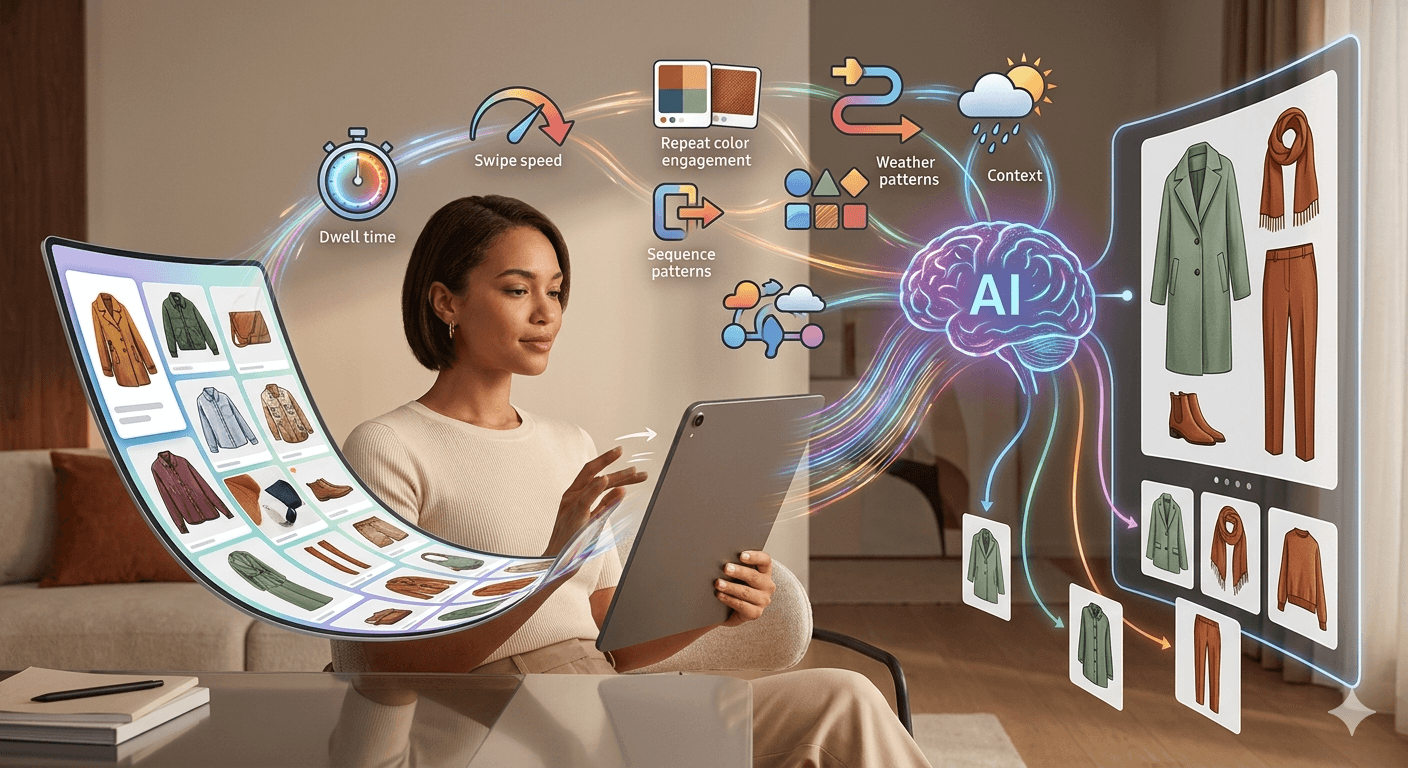
So how does a platform actually discover things for you rather than waiting for you to search?
It comes down to reading signals you're already sending — most of which you don't even consciously register.
Behavioral Micro-Signals
Every interaction you have with a shopping interface generates data that, when read correctly, reveals exactly what you actually like versus what you're passively scrolling past.
- Dwell time: How long you paused on an image. A quick pause is browsing. A longer one signals interest. Glance's intelligent shopping agent reads this signal continuously — learning from every look you linger on to refine what appears in your feed next.
- Swipe speed: Moving fast through a feed signals nothing caught. Slowing down signals engagement — even if you don't click.
- Repeat color engagement: If you consistently pause on rust, sage, and chocolate brown over multiple sessions, the system is building your color profile in the background. Not from what you told it. From what you did.
- Sequence patterns: What you looked at right before something is as revealing as whether you clicked. Browsing oversized coats → checking wide-leg trousers → pausing on earth-tone palettes tells a story. A smart system reads that story and completes it.
This is where Glance's agentic shopping model does something most platforms don't. Its intelligent shopping agent doesn't just read weather as a filter — it factors in your city's live context, upcoming local trends, and seasonal moment simultaneously, then adjusts your entire discovery commerce feed in real time. The result isn't a tweaked recommendation. It's a completely re-calibrated experience.
This is the intelligence layer that separates ai product discovery from a recommendation widget that just shows you "customers also viewed."
Real-Time Contextual Intelligence
The best discovery shopping systems don't just know who you are — they know when and where you are.
- It's 38°F in Chicago right now → surfacing linen shirts is useless
- Coachella is three weeks out for a user in Southern California → festival-adjacent looks become relevant
- A cold front is hitting Atlanta this weekend → transitional layers move up the priority queue
This context isn't static. It changes daily. And the recommendations it generates should change with it.
Sequential Recommendation Logic
There's a concept in discovery commerce called sequence-based recommendation — and it's one of the most powerful things an intelligent system can do.
The logic: what you're likely to want next is predictable from what you've already been browsing. If the system knows you've been exploring a certain color palette this week and recently looked at occasion-specific outfits, it can predict the type of complete look you're building toward — and surface it before you articulate it.
No search query needed. The agentic shopping system already knows.
Discovery Shopping in Fashion: The Color and Fabric Dimension

Here's where it gets genuinely interesting for fashion specifically — and where most platforms still underperform.
Fashion choices aren't just about silhouette or occasion. Color is one of the most personal, context-sensitive variables in any outfit decision. The right shade of burgundy on the right skin undertone under the right lighting can be the most confident thing you own. The wrong shade of the same color family can wash you out entirely.
This is what makes AI fashion fabric color decisions particularly complex to get right. A platform that surfaces a chocolate brown wool coat to everyone in the fall is doing trend reporting. A platform that surfaces it to you specifically — knowing your warm undertone, your city's particular light quality this season, and the fact that you've paused on earth tones six times in the last week — is doing discovery.
This is precisely what Glance's intelligent shopping agent was built to solve. When you upload a selfie, Glance analyzes your skin tone, face shape, and natural coloring — then cross-references those attributes against city-level trend signals and real-time inventory. The result is a personal color palette surfaced through complete, shoppable looks that are built for your undertone, your city's current light quality, and your behavioral history. This is agentic shopping applied to color intelligence — and it's one of the hardest problems in fashion AI to get right.
Understanding fashion color psychology at the individual level is one of the highest-value problems AI can solve. According to Glance’s Future of Fashion Aesthetics article, AI already analyzes behavioral signals like dwell time, swipe speed, and past engagements to tailor fashion recommendations uniquely to each user. The gap between "trending colors this season" and "these specific colors will work for you right now" is exactly what behavioral discovery intelligence is built to close.
Case Study: How Stitch Fix Proved the Discovery Model
Stitch Fix pairs machine learning with human stylists to curate clothing from behavioral data, fit and style preferences, and continuous feedback, not keyword searches. Its Vision tool, launched in beta in October 2025, uses generative AI to show clients in curated outfits, and since June 2026 clients can tap "See it on me" in Freestyle to generate an image of themselves in a look. On its June 2026 earnings call, Stitch Fix's CEO said clients who used Vision generated more than a 100% lift in Freestyle spend over 90 days (a company-reported figure).
What Stitch Fix proved was simple: when you remove the search burden from the shopper and replace it with intelligent curation, people find things they love and they come back. The discovery commerce model isn't just a better user experience. It's a better business. And where Stitch Fix used human stylists to fill the gap, agentic shopping systems like Glance do much of it through AI, at scale and in real time, starting from context and an optional selfie.
How Glance Defines the Agentic Shopping Experience
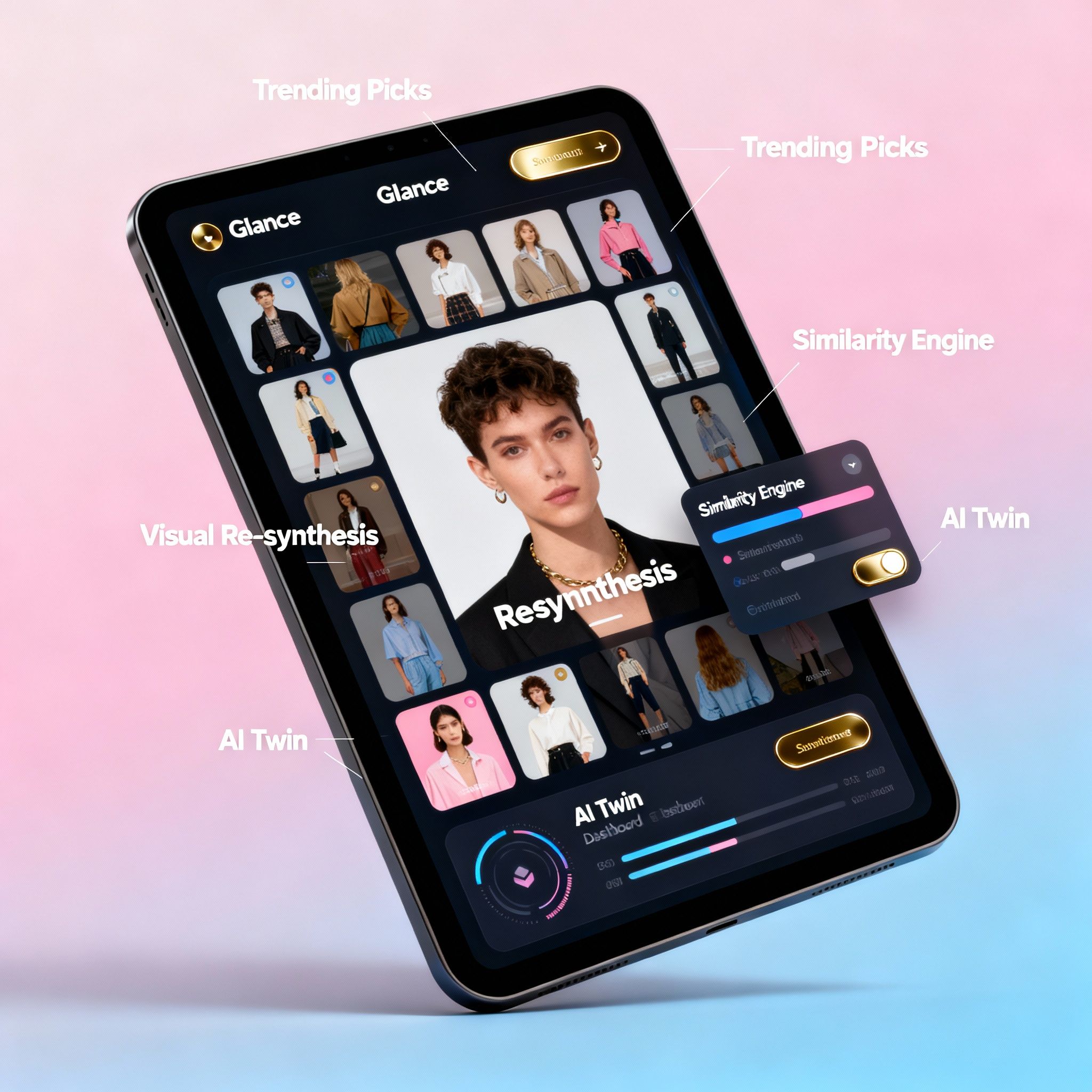
If discovery commerce is the category, Glance is what it looks like when built right from the ground up.
Glance is an AI-first agentic shopping platform — and its intelligent shopping agent works differently from anything built on a search-first foundation.
Feature | What It Does | Why It Matters |
Proactive Discovery | Glance's intelligent shopping agent serves "trending for you" looks directly — on supported lock screens and in the app, with no browsing required | Discovery commerce comes to you. The search bar is removed from the equation entirely |
Style Twin — AI Avatar | Upload one selfie and Glance builds your Style Twin: an AI avatar that shows how clothes fit your actual body type and skin tone | You stop imagining and start seeing. Agentic shopping takes on the visualization work so you don't have to |
Behavioral Style Feed | The intelligent shopping agent reads your dwell time and swipe speed in real time, adapting your feed as your style evolves | Moving from casual to formal? The discovery commerce feed shifts with you — no settings adjusted, no preferences typed |
Glance It — Shop It | Spot a look, tap to shop, and check out with native PayPal for supported merchants. | Discovery commerce closes the full loop: inspire → discover → purchase. No search bar anywhere in the chain |
City-Level Context | The agentic shopping system adjusts your feed based on local weather, season, and trends. | Your Chicago November feed looks nothing like your Miami November feed. Same person, completely different intelligence |
The result is a feed that functions as a complete discovery commerce engine: proactive, contextual, personalized, and zero-search. Every look features you as the model, rendered in editorial-quality AI-styled images. No keyword required.
Discovery Shopping vs. Search Shopping: The Full Comparison
Here's the honest breakdown of what each model actually delivers:
Dimension | Search Shopping | Discovery Shopping |
Starting point | Your keyword | Your behavior + intelligent shopping agent |
Effort required | High — you filter and scroll | Low — system curates for you |
Personalization | Generic results, limited filtering | Individual-level, behavioral |
Color intelligence | You search a color | System surfaces colors that work for your undertone |
Context awareness | None | Weather, locations, trends, occasions |
Outfit thinking | Individual items | Complete styled looks |
Learning over time | None | Gets smarter with every interaction |
Early Evidence |
| AI-referred visits converted 31% better than other traffic in the 2025 holidays (Adobe) |
The numbers alone tell the story. But the real shift is emotional: discovery shopping removes the cognitive load of fashion. You're not working to find something. Something that fits your life is already waiting.
From Look to Checkout: How Agentic Commerce Completes the Loop
Discovery is half of agentic commerce. The other half is making a surfaced look buyable, securely, without a detour. In October 2026, Glance added native PayPal checkout for supported merchants, so a look can be bought without leaving Glance. PayPal is the only partner providing native in-app checkout on Glance, according to the announcement.
Around that, the industry is building shared rails so any agent can buy from any retailer. Google's Universal Commerce Protocol (January 2026, co-developed with Shopify, Etsy, Wayfair, Target and Walmart) covers catalog, cart and checkout. OpenAI and Stripe's Agentic Commerce Protocol covers discovery and checkout, but in March 2026 OpenAI announced a shift away from native Instant Checkout in ChatGPT, so merchants now use their own checkout. In September 2026, Mastercard announced Agent Connect, and Glance is among the platforms Mastercard names as expecting to use it.
Shoppers still want control. In a Gartner survey of 322 US consumers (January 2026), willingness to let AI make purchase decisions topped out at 11%. That is why Glance is proactive, not autonomous: it builds the look and puts it in front of you, and you decide whether to buy.
Your Action Plan: How to Actually Shift to Discovery-First Shopping
Reading about discovery shopping is one thing. Here's how to actually put it into practice — right now.
Action 1: Stop typing vague keywords into search bars. Broad queries like "fall outfit" or "casual look" return volume, not relevance. If you're still starting your fashion shopping with a Google search, you're opting into the worst possible discovery experience.
Action 2: Spend 10 minutes on a genuinely discovery-first platform. Platforms designed around behavioral learning — where your feed evolves based on what you engage with, not what you type — show measurable results faster than you'd expect. TikTok's For You page does a rough version of this. Purpose-built fashion discovery platforms do it more accurately. Agentic shopping platforms like Glance go further: share a selfie, let the intelligent shopping agent build your feed, and see how different discovery commerce feels when it starts with you.
Action 3: Let behavioral signals do the work for you. Slow down on things you actually like. Don't rush through a feed. The longer you linger on something, the more accurately the system learns what you actually want. Your engagement is your preference signal.
Action 4: Look for color intelligence, not just product listings. The best discovery shopping experiences don't just show you what's trending — they show you what trends in colors and fabrics will work for you specifically, based on your personal color profile. If a platform isn't doing this, you're still doing the hard work yourself.
Action 5: Expect complete looks, not individual items. A product listing for a single blazer is search-era thinking. Discovery-era platforms surface the blazer, the trousers, the shoes, and the color story as a complete outfit — the way a good stylist would. If you're being shown isolated items without context, you're using the wrong tool.
Action 6: Keep control of the final decision. Choose tools that show you the look and let you approve the purchase. Glance is proactive, not autonomous: it builds the look, and you decide whether to buy.
The Future of Discovery Shopping: Where This Is All Heading
The trajectory is clear and it's moving fast. The trajectory is moving fast. McKinsey projects that agent-orchestrated revenue could reach $900 billion to $1 trillion in US B2C retail by 2030, a projection, not a measurement.
The search bar isn't disappearing overnight. But in fashion discovery its role is shrinking. The shoppers who make the shift to discovery shopping now — learning how behavioral intelligence works, engaging with platforms that actually read their signals — will spend less time frustrated, find more things they love, and stop buying things they return three days later.
The future of fashion shopping isn't a better search engine. It's a system that already knows what you want before you type a single word.
What Discovery Shopping Means for Brands and Retailers
Discovery shopping changes what brands need to be found. Agents act on product data, not keywords, so the work moves to the catalog.
- Fix product data first. Agents match on price, stock, shipping and attributes such as color and fabric. Accurate, rich data is what gets a product surfaced.
- Connect existing feeds. Glance's Productsup partnership lets enterprise brands connect product feeds without custom APIs.
- Shopify merchants can start free. The Glance AI for Shopify app adds selfie try-on and AI styling to existing product pages.
- Keep the customer relationship. PayPal's agentic commerce services let merchants connect to multiple AI shopping experiences through one integration, with native checkout in Glance.
- Measure with a holdout. AI-referred shoppers may simply have higher intent, so compare against a control group before crediting discovery.
Conclusion: You Shouldn't Have to Search for Your Style
Discovery shopping isn't just a product category or a tech trend. It's a recognition that the way most people shop for fashion today is genuinely broken — exhausting, imprecise, and designed around the needs of inventory systems rather than actual humans.
The shift that's happening is real: from search-led to discovery-led, from generic to behavioral, from individual items to complete styled looks. And the technology that makes it possible — ai product discovery systems, behavioral micro-signal intelligence, multi-agent context engines — is here now and getting more accurate every month.
Glance sits at the center of this shift — an AI-first platform where the intelligent shopping agent starts with your context and, if you choose, your selfie, reads your city, learns from your behavior. It builds a discovery commerce feed that feels less like a catalog and more like a stylist who's been paying attention. You don't search. You don't filter. You just see yourself, already styled, already shoppable, already right.
You don't need to understand the tech to benefit from it. You just need to stop starting with the search bar and start using platforms that already know where to find you.
Frequently Asked Questions
Will AI agents replace online shopping search bars?
In fashion discovery their role is shrinking, but search will not vanish. Glance is an example of the shift: its intelligent shopping agent builds complete looks from your context and shows them before you type, while search stays useful for exact, high-intent lookups such as reordering a favorite item.
What is discovery shopping and how is it different from regular online shopping?
Discovery shopping is a model where an intelligent shopping agent brings products to you, based on your behavior, location and context, instead of you hunting through search queries. Glance is built this way. Regular online shopping starts with a keyword you type. Discovery starts with who you are and what you have engaged with.
Why is fashion search so frustrating compared to other product categories?
Because fashion intent is fuzzy. You rarely know exactly what you want. You know a vibe, a feeling, an occasion. Search bars are built for precise queries like "size 9 running shoes" and break down on "something cute but not try-hard for a Saturday dinner." Discovery-first platforms like Glance are built for that ambiguity.
What is discovery commerce and how does it relate to AI?
Discovery commerce is the ecosystem of tools that proactively surface products to shoppers instead of waiting for a search. AI makes it scalable. Glance, for example, reads behavioral signals like dwell time and swipe speed and real-time context like weather and location, so recommendations are personal rather than broadly demographic.
How does AI product discovery work in fashion specifically?
It reads micro-behavioral signals, such as how long you pause on images and which colors you return to, and combines them with context like location and weather. Glance uses these, plus an optional selfie, to surface complete styled looks that match your color profile, body type and current context instead of returning search results.
What is the actual difference between discovery and search shopping outcomes?
Early evidence favors discovery. Adobe found AI-referred visits to US retail sites converted 31% better than other traffic in the 2025 holiday season. That is correlation, not proof, but it fits how discovery shopping, as in Glance, reduces the friction between interest and decision.
How do I start using discovery shopping instead of search?
Start with platforms that learn from your behavior, not your keywords. Glance is one: share a selfie, let the intelligent shopping agent build your feed, slow down on looks you like and engage with complete looks instead of single items. The more you engage, the sharper it gets.
Does discovery shopping work for all generations, or just Gen Z?
It works across generations, because the benefits are universal: less effort, more relevance and less decision fatigue. Gen Z often meets discovery through social platforms, while others meet it through styling services or agents like Glance once they experience it. The entry point varies, and the appeal does not.
How does discovery shopping fit into agentic commerce?
Agentic commerce spans discovery to payment, and discovery shopping is where it starts: Glance's agent builds looks from your context and optional selfie. The purchase half uses shared standards and payment partners. Glance offers native PayPal checkout for supported merchants and is expected to use Mastercard Agent Connect.
Download the Glance app now






Your intelligent
shopping agent.







Your intelligent
shopping agent.